
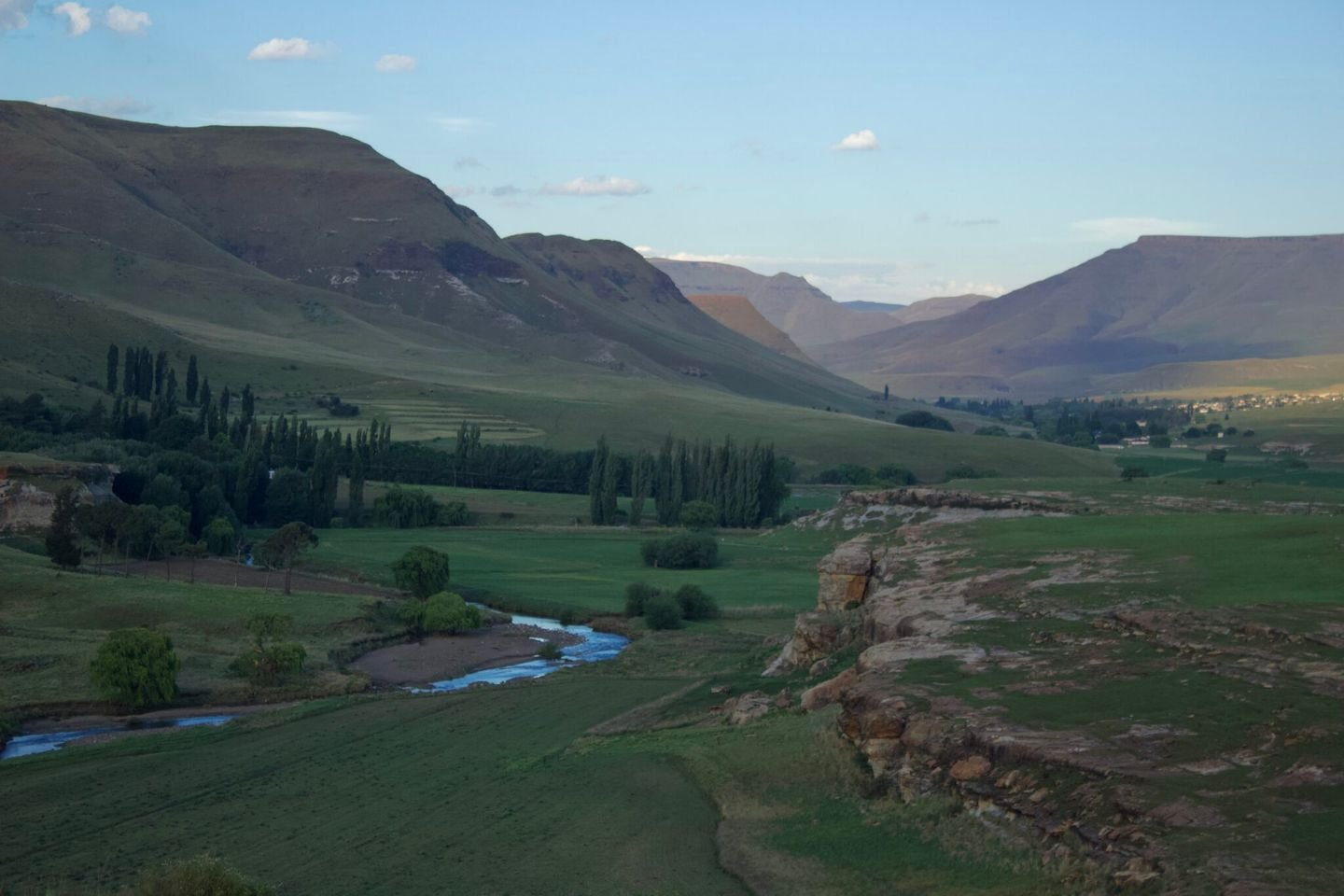
The summer green of the trees romanced our hearts at once.
I wondered whether I’d recover and after how many days, from the sights of the willows. Their wisdom drapes, they no nothing of shy humility.
The poplars and cypresses, well these ones, have one common purpose: to reach ever higher. In them is no ambition to spread their branches wide. Why? Well, the oaks, pear trees and even the birches have the wide-spreading of arms covered.
…blessed birch. Splendid white trunk. Bold scrapes of brown hint at an abstract nature, that of a foreign impressionist who has acculturated and weathered through adaptations and now thrives in a place of its own. The calmest of shaded greens for a dress are its leaves. The birch is more than worthy to wonder and woo anyone who has attention to spare.
None of these trees are from here. None of them are indigenous. Their roots trace back to distant shores and distant woods. Here they stand. Aged, tall, broad, and deeply rooted in southern African soil. And the romance of it all is that they’re above the tree-line!
Above the tree-line means that, up until a certain height trees will grow but not further up. Trees don’t grow here, not naturally. Yet further up and further in these exotic members do. These other-worldly trees have their home in a hamlet in the Eastern Cape highlands. They’ve long since passed the period of experiment to see whether they will last. This is their place.
Travel to places like this sure brings out the learner in me. Travel in general brings out the child in me. There is in fact no choice in the matter, travel reduces me to a learner child, especially when it comes to communicating. In North Africa I just went through the monotonous ritual of trying to explain to certain Arabs and Amazigh’s, who don’t believe white people live in South Africa, that they do. This wasn’t the first time I had a conversation like this, and I’m sure it won’t be my last:
“Ok, ok, but where does your father come from?”
Me: Afrique du Sud. Genoub Afric. South Africa.
“Hm. Ok. And your grandfather?”
Me: Kiff Kiff. South Africa.
“No, Europa!”
Me: Ok. Ok. Ten generations ago, Europeans came to South Africa. I get you. But I still come from South Africa.
“Oui! Oui! Europa! French or German or…?”
Me: “Voila… you name it, I’ll be it” … I rest my case.
Getting a handle on the mindsets of North Africans can be tricky. The most indigenous peoples are the Amazigh, or more commonly known in the West as: Berbers. One translation of the word “Amazigh” means “free man”. As a people their ways are festive. They love their dress is colourful. They love their music, instruments and the fruit of the vine. They love their freedom!
Enter the Arabs. The Arab conquest brought new ways and mindsets to North Africa from round about the 7th century. One of these mindsets, which tends to be common throughout the Middle East, is that religion and culture are one and the same thing. To put it plainly this could be translated to mean the following: if I come from Europe or America, I will, or should, be Christian. If I come from and look like a Far East Asian, I will, or should, be Buddhist. If I come from and look like an Indian, I will, or should, be Hindu. Therefore today, North Africans will, or should, be Muslims.
Culture. Religion. Kiff-Kiff. Same.
For both of these, Amazigh and Arabs, their language and culture are so ancient that the nearly 400-year history of Europeans living in Southern Africa, seems almost irrelevant. Especially for two of the oldest languages and cultures out there.
Enter Le bleu! Much later than the Arabs, the French would arrive on the shores of North Africa too, bringing their own mindsets and flavours of influence. Croissants for one, which apparently isn’t originally French. Haussman-style buildings, which sounds more German but is French. Catholic churches and French schooling systems, which probably had the most enpowering effect of French occupation. There’s little doubting that North Africans value education differently than what they had before the French came.
Today the independent nations that make up North Africa are a hybrid dynamic of cultures, with strong ties to both the Arab world and the French. Before either of these influencers arrived, North African civilisation was Romanised too. Before the Romans, the Phoenicians and Numidians, with Pharaohs as leaders, also occupied and influenced in this region. All this to touch on who the native Amazigh people have rubbed shoulders with.
Now then, what do these occupiers and their ways have to do with the exotic trees I’m surrounded by in the Eastern Cape Highlands?
Well, in short, these highland trees are seemingly above the common laws of nature. They thrive above the tree-line! They are not originally from this area, yet as exotics they don’t occupy in the place of indigenous trees. They were planted where no other trees grew. These trees embedded themselves in a region where no other trees had lived before them.
They are above reproach. They are different… not inherently Southern African, yet they exist as though they are. They are experiments that have proven true! They were uprooted to be planted elsewhere, and when the Carpe Diem moment came, they took root and flourish to this day in southern African highlands… above the tree-line!
This is no commentary on the effects of foreign occupation. This is me as a learner child wanting to entertain you with what I’ve discovered through my travels. This is also a memoire for the people I know in high and low places, who’s lives are like these trees – above reproach, above the tree-line:
An Ethiopian who lives to bless, through his music and chorusses, the Arab Gulf region where he lives. A young Russian lady who’s lived alongside the Ganges river, with the weak and poor. A family of six from both the UK and USA, who’s cross-pollenated lives tell of another way amongst people from the westerly province of China. Two unmarried Turkish sisters who have bridged many a cultural difference by shamelessly taking up residence in the highlands of Central Asia.
…Two Amazigh brothers, amongst others, who recently took to ship and docked at a range of ports all along the African continent, to facilitate the introduction of literature for the heart, to various African peoples.
Exotic. Indigenous. Foreign. Native. White. African. North. South. Highlands. Coastal ports. Free… “You name it, I’ll be it!” These above-mentioned men and women are free men and women. Their sustenance is the nearness of heaven. Citizens they are of a heavenly country.
And its their very citizenship that make their lives something worth wondering at… above the tree-line!